




A good gallery wall layout starts with one anchor piece, 2 to 3 inches between pieces, and the center of the whole group at 57 to 60 inches from the floor. Trace every piece on paper, tape the templates to the wall, and rearrange them until the arrangement looks balanced. Only then do you mark a single hook position.
- Leave 2 to 3 inches between neighboring pieces and keep that gap the same across the whole wall.
- Center the group at 57 to 60 inches from the floor, or set its bottom edge 6 to 10 inches above a sofa or console.
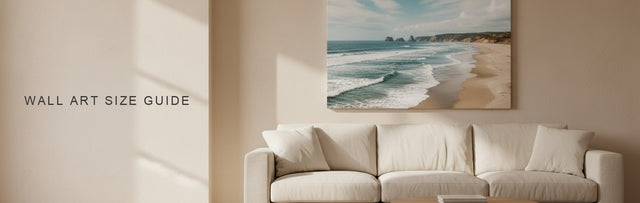
- Six 16x16 inch squares in two rows of three fill a 52 by 34 inch block, a good fit over a sofa.
- Paper templates taped to the wall let you move the layout around before any hook goes in.
- Gallery walls in 2026 favor fewer, larger pieces and more breathing room over a crowded grid.
How Do You Plan a Gallery Wall Layout?
Plan it on the floor or on paper before you touch the wall. Pick the anchor piece first, usually the largest or darkest, then arrange smaller pieces around it until the outer edge forms a loose rectangle. Keep the gap between pieces to 2 to 3 inches. Tighter looks cramped and wider makes the pieces drift apart.
Work in order: choose pieces, measure the wall, trace templates, arrange, hang. Most mistakes come from skipping the third step, because a layout that looks fine on a screen often changes when real sizes meet a real wall.

How Big Should a Gallery Wall Be?
The whole group should fill about two thirds to three quarters of the width of the furniture beneath it. Above an 84 inch sofa that is a block 56 to 63 inches wide, and above a 48 inch console it is 32 to 36 inches. Measure the furniture first, then add up the widths of your pieces and the gaps.
| Layout | Pieces | Total width x height | Suits |
|---|---|---|---|
| Grid of six squares | Six 16x16, 2 in gaps | 52 x 34 in | Above a sofa or bed |
| Anchor plus tall companion | One 36x24 landscape, one 12x24 portrait, 2 in gap | 50 x 24 in | Above a loveseat or console |
| Row of three landscapes | Three 24x16, 2 in gaps | 76 x 16 in | Long wall or hallway |
| Square of four | Four 20x20, 2 in gaps | 42 x 42 in | Entry or narrow wall |
Pro tip: Align edges, not centers. Keeping the top or bottom edges of a row on one line looks tidy even when the pieces differ in size, and it is easier to measure than matching midpoints.
What Is the Rule for Gallery Walls?
There are three rules worth following. First, hang the group so its center sits 57 to 60 inches from the floor, which is average eye level. Second, above furniture, leave 6 to 10 inches between the furniture top and the lowest piece. Third, keep every gap between pieces the same, 2 to 3 inches.
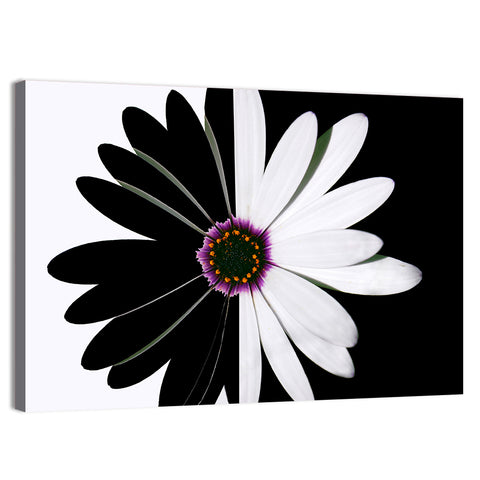
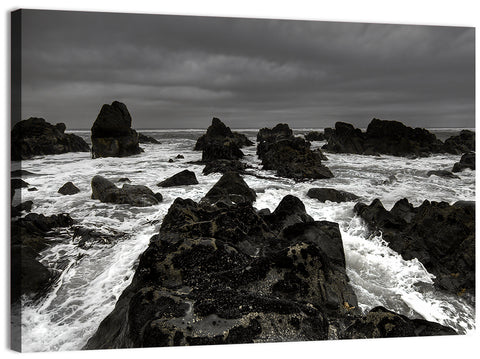
Everything else is taste. A group of 5 to 7 pieces with a shared color scheme, such as black and white, ties together even when the sizes vary. Our guide to wall art sizes for every wall covers how large each piece should be.

How Do You Put a Gallery Wall Up With Paper Templates?
Cut a paper template for each piece, tape them to the wall and live with the layout for a day. Kraft paper or newspaper works. This costs nothing and fixes problems before any hardware goes in.
- Trace each piece on paper and cut it out at the exact size.
- Mark where the hanging point sits on each template, measured down from the top edge.
- Tape the anchor template to the wall with its center at 57 to 60 inches from the floor.
- Tape the others around it, with 2 to 3 inches between each, and step back across the room.
- Mark each hanging point through the paper, remove the template and put in the hook or strip.
- Hang the anchor first, then work outward, checking level as you go.
Watch out: Hanging points are not at the top edge of the piece. A wire or sawtooth hanger sits an inch or two below, so measure from the hook to the top edge, or your carefully spaced gaps will shift. If you prefer no holes at all, read our guide to hanging pictures without nails.

Which Gallery Wall Layout Works Best?
Grid Layout
A grid uses identical sizes in even rows. It is the easiest to plan and the most formal. Six square pieces in two rows of three look calm above a sofa, and the strict rhythm suits modern rooms.
Salon Layout
A salon layout mixes sizes and shapes, anchored by one large piece. Keep one edge, either the bottom of the row or the outer rectangle, straight. Let the inside vary, and the mix reads as intentional. A trip photo wall works well this way, and travel wall art and ways to hang your trips shows how.
Vertical Layout
Narrow walls, stairways and spaces beside a door suit a vertical column. Three 12x24 inch portraits stacked with 3 inch gaps rise 78 inches. For a column on a staircase, follow the angle of the stairs, not the floor, and keep the gap constant. Our vertical wall art covers the shapes that fit.

Are Gallery Walls Still in Style in 2026?
Yes, though the look has loosened. Decor retailers' 2026 trend roundups describe gallery walls as more personal and less matched, with fewer, larger pieces and more empty wall between them. Rigid grids of identical frames feel dated to some designers, while a clean grid still works in a modern room.
These are opinions from stores that sell art and frames, not measured data, so treat them as direction, not rules. If you want a quieter look, choose three to five pieces from one color family. A palette of black and white is the safest, since it also hides small differences between pieces. See our black and white art for separate pieces that share a scheme.

You want a gallery wall above an 84 inch sofa whose back is 34 inches tall. Two thirds to three quarters of 84 is 56 to 63 inches. Six 16x16 inch squares in two rows of three with 2 inch gaps make a block 52 inches wide and 34 inches tall (16 plus 2 plus 16). Set the bottom row 6 inches above the sofa, which puts its bottom edge at 40 inches. The top edge lands at 74 inches, and the center of the block sits at 57 inches, right on the guideline.
Every piece is printed to order and ships free across the US. Choose pieces in one shape for a grid, or mix shapes for a salon wall.
Square canvas prints Wall art posters Framed wall art for living room
Quick answers
Common Questions
How do I plan a gallery wall?
Choose an anchor piece, trace every piece onto paper and tape the templates to the wall. Rearrange them with 2 to 3 inches between neighbors until the outline looks balanced, with the group centered 57 to 60 inches from the floor. Mark the hanging points through the paper, then hang the anchor first and work outward.
How far apart should pictures be on a gallery wall?
Leave 2 to 3 inches between pieces, and keep the gap identical across the wall. A smaller gap reads as one cluster and a larger one reads as separate pictures. If your pieces are large, such as 36x24 inches, stay near 3 inches, and for small pieces such as 12x12, use 2 inches.
What is gallery style framing?
Gallery style framing means displaying several separate framed pieces together on one wall, usually with matching or coordinated frames and even spacing. The group is planned as a single composition with a shared color story and a consistent gap, so the wall reads as one display, not a pile of unrelated pictures.
Are gallery walls outdated in 2026?
No, but the crowded, matching-frame version is fading. Decor retailers' 2026 trend pieces point to fewer, larger pieces with more space around them and a more personal mix. A calm layout of three to five pieces in one color family is current, and a tidy grid still suits modern rooms.
How high should a gallery wall be hung?
Hang the center of the whole group at 57 to 60 inches from the floor. Above a sofa or console, set the bottom edge 6 to 10 inches above the furniture instead. For a tall group, let the lower edge decide the height, and check that the center still falls close to eye level.